−15%
 −15%
 −15%


Varieties
Vanilla crystallization: aromatic excellence in its pure form
Read the guide
Key takeaways
- Some vanillas naturally develop crystals on their surface.
- Frost does not appear on every species or on every origin.
- These vanillas can be used in creams, ganaches and pastry preparations.
In the world of haute gastronomy, frosted vanilla – or crystallized vanilla – represents the pinnacle of quality. These crystals are highly prized because they are synonymous with a high concentration of natural aromas. They reflect a bean that has been well ripened, well fermented and properly cured. This frost does not always appear: it is a natural phenomenon that testifies to an extreme saturation of the bean with essential oils and aromatic molecules.
The natural mechanism of vanilla frost
The crystallization process is closely linked to the ripeness of the fruit. In certain exceptional origins, the beans split naturally on the plant at the end of ripening. It is at this precise moment that molecular concentration reaches its peak. As it opens, the bean releases its aromas and allows the components to set on the surface in the form of crystals. However, not all species and origins visibly produce these vanillin crystals — even though the quality remains excellent — and other species, for their part, produce coumarin crystals.
Vanillin crystallization: the white gold of Vanilla planifolia
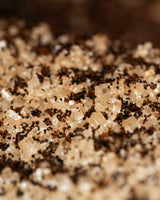
On the Vanilla planifolia variety (notably from Madagascar or Mauritius), pure vanillin crystallization can be observed. Small white crystals form naturally around the beans, giving them a frosted appearance and a striking look. This happens when the vanillin concentration is very high, exceeding 2.3%. This vanillin frost is also found in other exceptional terroirs, such as the frosted Planifolia from New Caledonia, the one from Réunion, the rare frosted vanilla from Brittany, or the Tanzania and Indonesia Sulawesi origins.
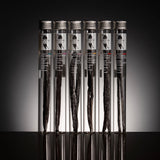
These crystals are a sign of the vanilla’s exceptional quality and testify to an optimal maturation process. Besides its olfactory power, vanillin is a natural antiseptic: this is what allows the beans to be kept for many years without deteriorating. For optimal storage that preserves these precious crystals, using an airtight glass tube is ideal. When tasted on its own, this extreme concentration causes a slight tingling on the tongue, before an intensely vanilla flavor bursts forth.
Coumarin crystallization: the complexity of Vanilla pompona
The frost takes on a completely different form — and another aromatic dimension — on rarer varieties such as Vanilla pompona. These beans tend to crystallize in the form of coumarin. Visually, the phenomenon is disconcerting: you might mistake it for mold, with an appearance reminiscent of a fine spider’s web.
Yet it is a true organoleptic marvel. Unlike the sweetness of vanillin, coumarin is very bitter on the attack. It then reveals powerful, complex and deep notes, evoking blond tobacco and tonka bean — as in our pompona vanilla from Peru, the pompona from New Caledonia or the one from Brazil. A radically different taste experience, prized by chefs in search of out-of-the-ordinary aromatic signatures.
Why choose a crystallized vanilla?
Whether it is the pure brilliance of vanillin or the complexity of coumarin, crystallization is the absolute guarantee of a spice saturated with active compounds. It is the preferred choice for enhancing creams, ganaches and the most demanding pastry creations, where every seed and every crystal infuses the preparation with unrivaled intensity. Discover all our exceptional vanillas and our frosted vanillas from Madagascar.