−15%
 −15%
 −15%


History
A vanilla grown in Brittany: the story of France’s most improbable bean

Key takeaways
- This vanilla is grown in the Côtes-d’Armor, in a controlled environment.
- Each flower is pollinated by hand.
- Its woody, milky profile lends itself to creams, ice creams and milk-based desserts.
There is a vanilla bean in France that, logically, should not exist. It did not ripen under the Madagascar sun, nor in the humidity of a Polynesian lagoon. It grew in the Côtes-d’Armor, under the changing skies of Brittany, a stone’s throw from the English Channel. A tropical orchid among the most demanding in the plant world, grown flower after flower on a land of granite and sea spray: this is, without doubt, the most improbable bean in France.
At Galand Vanille, we personally select and taste every origin we offer. The day this vanilla from Brittany arrived in our hands, we understood that it was not a mere botanical curiosity, but a vanilla of very high caliber, with a personality found nowhere else. Here is its story.
An improbable encounter: a tropical orchid under Breton skies
Vanilla is the fruit of a climbing orchid, a plant that, in its natural state, only thrives in the hot, humid climates of the tropics. Madagascar, Tahiti, Papua New Guinea, Peru: all the great origins we work with share this same geography of sunshine. Brittany, for its part, is famous for its artichokes, its oysters and its lightly salted butter. Not for its tropical orchids.
And yet. In the Côtes-d’Armor, a somewhat crazy bet was made: since vanilla cannot come to the Breton climate, the tropical climate would come to it. Rather than forcing the plant to adapt, the exact conditions it needs to flourish were recreated around it. The result is a French vanilla in the fullest sense of the term: born, grown, pollinated and harvested on French soil, a few hours’ drive from our kitchens.
What could have remained a laboratory experiment has become real production, with successful harvests in 2023 and 2024. Two vintages proving that vanilla grown in France is no longer a utopia, but a reality you can hold between your fingers.
How is vanilla grown in Brittany?
The secret comes down to one image: an eternal tropical spring. Breton vanilla grows in an entirely controlled environment, where humidity and temperature are constantly regulated to simulate, day after day, the conditions of a tropical forest understory. While the rain sweeps the moorland outside, the vine lives in constant mildness, never experiencing frost or heatwaves.
But technology is far from everything. As everywhere else in the world, the vanilla flower cannot be fertilized without the intervention of a human hand: each flower is pollinated by hand, one by one, in the short window when it opens. It is a goldsmith’s work, the same precise gesture as that of the pollinators of Madagascar or Tahiti, transposed under Breton skies.
This care shows in the fruit. The beans obtained are particularly plump, frosted and fragrant, and weigh more than 4 grams each: a remarkable size, the sign of a plant grown without stress and harvested at full maturity. With a moisture content of about 30%, they fall into the gourmet grade, that of the supple, oily beans sought after by pastry chefs.
A curing process in three acts: freezing, drying chamber, crystallization
Harvesting a beautiful green bean is only half the journey. It is curing that transforms an odorless fruit into a concentrate of aromas, and this is where Breton vanilla clearly departs from the beaten track. Its curing lasts 9 months and follows a singular process, in three acts.
- Freezing. Where tradition dips the beans in hot water to stop their vegetative life, the Breton bean is first frozen. The cold triggers the enzymatic work that will release the aroma precursors.
- Drying in a drying chamber. Next comes a slow, controlled drying in a drying chamber, which concentrates the juices and gradually brings the bean to its ideal moisture content, without ever rushing it.
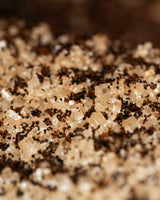
- Crystallization. Finally, the most spectacular act: the bean frosts. Natural vanillin crystals appear on its surface, like a veil of white frost on a shiny black bean.
This frost is neither a defect nor an artifice: it is vanillin itself, the aroma at the heart of vanilla, migrating to the outside of the bean and crystallizing. We have devoted a full article to vanilla crystallization, this rare and sought-after phenomenon that marks the richest beans. Lovers of these frosted beans will find what they are looking for in our collection of frosted vanillas.
What Breton vanilla offers on the palate
Now for what matters most: the taste. When tasted, Brittany vanilla unfolds a profile of woody notes, very vanilla-forward, with a succession of chocolatey notes, a touch of leather and white flowers. Two signatures make it instantly recognizable: a hint of coastal minerality, like a distant echo of sea air, and a milky roundness of uncommon softness.
Paul Galand, who tastes and selects every batch himself, sums it up like this: “For me, Breton vanilla is a true feat. What I admire is this ability to tame the exotic and adapt it to our lands. It has a milky roundness found nowhere else, almost as if the sea air had infused the bean as it grew. It is the ultimate luxury of vanilla: rare, local and of absolute purity.”
To place this bean among the great origins, here are its characteristics at a glance.
| Characteristic | Vanilla from Brittany |
|---|---|
| Place of cultivation | Côtes-d’Armor, controlled environment |
| Pollination | By hand, flower by flower |
| Bean weight | More than 4 g, plump and glossy beans |
| Moisture | About 30% (gourmet grade) |
| Curing | 9 months: freezing, drying in a drying chamber, crystallization |
| Aromatic signature | Woody, chocolate, leather, white flowers, coastal minerality, milky roundness |
| Available harvests | 2023 and 2024 |
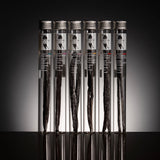
| Packaging | Glass tube |
Compared with a Bourbon vanilla from Madagascar, the benchmark among the great cocoa-like and indulgent classics, the Breton bean plays a fresher, more floral score, with that milky character all its own. It is not an imitation of tropical vanillas: it is an origin in its own right.
Why a French vanilla changes the game
Beyond the agricultural feat and the pleasure of tasting, vanilla grown in France shakes up a few well-established certainties.
- An ultra-short supply chain. Almost all the vanilla consumed in Europe crosses half the globe before reaching the kitchen. This one travels a few hundred kilometers, with no intercontinental transport at all.
- Total traceability. From the hand-pollinated flower to the glass tube, every step takes place in France, before our eyes. No opaque intermediary, no gray area: it is the natural extension of our vanilla direct from the growers approach.
- Controlled freshness. No long months in a container, no breaks in the logistics chain: the bean reaches you in exactly the condition in which it left curing, protected by its glass tube.
For a house like ours, which stands for the taste of a job well done and transparency in the supply chain, this Breton bean is more than a product: it is a demonstration. Proof that a French terroir, helped by patient know-how, can bear one of the most precious spices in the world.
Who is this exceptional bean for?
Let’s be honest: Brittany vanilla is not an everyday vanilla. Its rarity makes it a bean you choose for specific moments.
- The curious and collectors of flavors, who want to discover an origin that almost no one has tasted yet.
- Demanding pastry chefs, fond of creams, ice creams and milk-based desserts where its roundness finds a natural setting. To match each origin with the right dessert, our guide which vanilla for which recipe will help you.
- Lovers of local produce, happy to cook with a tropical spice born in France, with no compromise on quality.
- Those looking for a gift that tells a story: a frosted bean of more than 4 grams, in its glass tube, with Brittany as its origin, always makes an impression.
One last sourcer’s tip: a bean of this caliber deserves to be treated well. Keep it in its tube, away from light and temperature swings, and it will repay you for months. Our complete guide to storing vanilla details the right steps.
Frequently asked questions
Is Brittany vanilla really grown in Brittany?
Yes. It is grown in the Côtes-d’Armor, in a controlled environment where humidity and temperature are regulated to recreate an eternal tropical spring. Each flower there is pollinated by hand, and the 2023 and 2024 harvests were grown there.
Why is the bean covered with white crystals?
This frost consists of natural vanillin crystals, which appeared during the crystallization phase of curing. It is a sign of great aromatic richness, not to be confused with mold: the crystals are shiny, dry and melt under the finger.
What does Breton vanilla taste like compared with a classic vanilla?
It offers a woody, very vanilla-forward profile, with notes of chocolate, leather and white flowers, enhanced by coastal minerality. Its most singular signature remains its milky roundness, found in no other origin.